The Soup That Waits in Tamana: A Taipien Field Guide
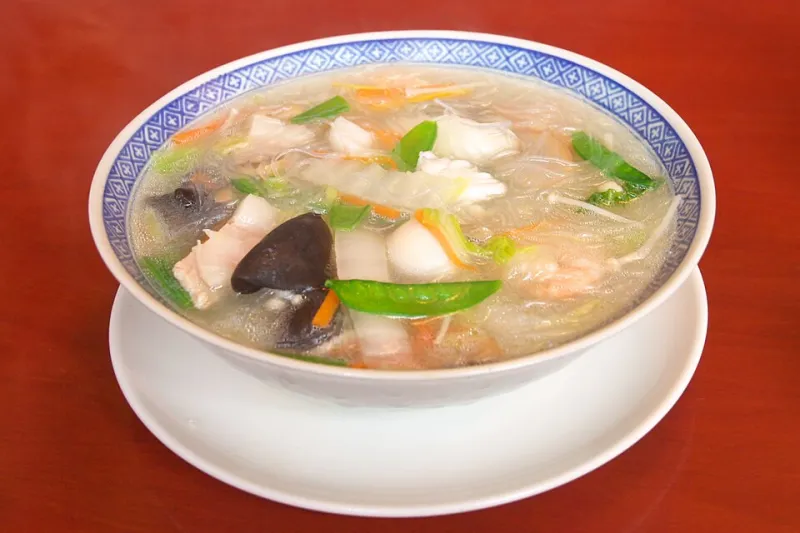
Photo: woinary from Chinese restaurant Unnan in Kumamoto, Kumamoto, CC BY-SA 2.0, via Wikimedia Commons
Most travelers come to Kumamoto with ramen on the brain. Fair enough—the city has a deep, porky tonkotsu tradition, and a bowl of it at 11 a.m. is one of the great travel pleasures. But there's another noodle soup in this part of Kyushu that rarely gets the spotlight, and it happens to be one of the most distinctive bowls in Japan. It's called taipien, and it doesn't shout. It waits.
You'll see the word on plastic banners outside neighborhood shokudo, on laminated menus in Tamana, and on the specials board at counters in Kumamoto City. Order it and you get something that looks less like ramen and more like a stew that decided to become soup: a pale, thick broth crowded with vegetables, seafood, pork, and chewy wheat noodles. It is gentle, salty, a little sweet, and deeply satisfying. It is also the kind of dish that makes a detour feel like the main event.
What Is Taipien, Exactly?
Taipien is a noodle soup from Tamana, a small city in northern Kumamoto Prefecture, and it has Chinese roots. The name is usually written in katakana, but it comes from the Chinese characters for "peace" and "swallow"—a pairing with celebratory overtones. The local version, though, has drifted far from any original. It is built on a broth that's thickened until it coats a spoon, often with pork, shrimp, squid, cabbage, carrots, onions, bamboo shoots, and fish cake. A boiled egg frequently shows up. The noodles are springy and wheat-based, sturdy enough to hold their own against the weight of the soup.
What separates taipien from ramen is not just the thickness. It's the balance. There's no heavy tare or slick of pork fat dominating the bowl. The broth tastes like the sum of its ingredients—sweet cabbage, briny seafood, savory pork—rather than a single loud flavor. It's a bowl you can eat in the middle of a long driving day without feeling like you need a nap afterward. That matters when the afternoon plan involves volcano roads or castle stone.
A Chinese Soup That Learned a Kumamoto Accent
The story locals tell is that taipien arrived in Tamana by way of Chinese traders and cooks, and that a local restaurant adapted it into the dish we know now. The exact details get fuzzy depending on who's telling the story, which is normal for regional food. What's clear is that Tamana, with its connections to the Ariake Sea and its long history of shipping and trade, was exactly the kind of place where a Chinese soup could land and then change.
And change it did. The Japanese version is less about dumplings or delicate swallow-shaped wrappers and more about a generous, everyday bowl—the kind of thing a family might order at a local restaurant on a Sunday. Over time, taipien became a point of civic pride in Tamana. You'll see it on signs, in local guides, and on menus that otherwise look like standard Japanese diner fare. It is not a museum piece. People eat it for lunch.
The Bowl Itself: What to Expect
The first spoonful is a texture surprise. If you're used to thin, clear broths or rich tonkotsu, taipien's consistency takes a second to adjust to. It's not gluey, but it has body—almost like a savory gravy that's been thinned just enough to slurp. The toppings are cut small, so every spoonful gets a little of everything. The noodles are chewy and slightly irregular, and they hold the soup well.
Ordering is straightforward. At most shops, taipien is a set menu item, often with rice or a side of pickles. Some places offer a spicy version, and a few add extra seafood. If there's a bottle of pepper or vinegar on the table, use it sparingly—the broth is balanced, and you don't want to bury the vegetables. First-timers should get the standard bowl. Save the variations for trip two.
Where to Find It: Tamana First, Then the City
If you want the origin-story experience, go to Tamana. The city sits within easy reach of Kumamoto City by train, and the town center has a handful of shops that serve taipien as their signature dish. Look for the modest storefronts near the station and the local shokudo with photos in the window. Lunch is the safe bet; many places close after the midday rush. This is not a late-night food. It's a midday bowl.
In Kumamoto City, taipien shows up at Chinese-Japanese restaurants and local diners rather than dedicated ramen counters. That's part of the appeal. You can pair it with gyoza or fried rice and end up with a very good, very unfussy meal. The city's tram network makes it easy to hop off at a random stop and walk until you see a banner. That's a legitimate strategy here.
The one thing to know is that taipien isn't everywhere. It's a regional specialty, not a national one. If you see it on a menu, order it. You may not get another chance on the same trip.
Why It Belongs on Your Itinerary
Kumamoto rewards travelers who slow down. The castle walls, the caldera roads, the steam rising from onsen towns—these are the headline acts. But the food memory you carry home is often the unexpected bowl in a quiet town. Taipien fits that role perfectly. It's a detour food: humble, specific, tied to place. It doesn't need a reservation or a hype line. It just needs you to show up hungry.
And if you're the kind of traveler who plans around lunch, this is a good one to plan around. Take the train to Tamana, walk a few blocks, and sit down to a bowl that tastes like a hundred years of local adaptation. Then get back on the road, with the volcano still on the horizon and the soup still warm in your chest. That's the Kumamoto rhythm: stone, steam, and a slow bowl in between.